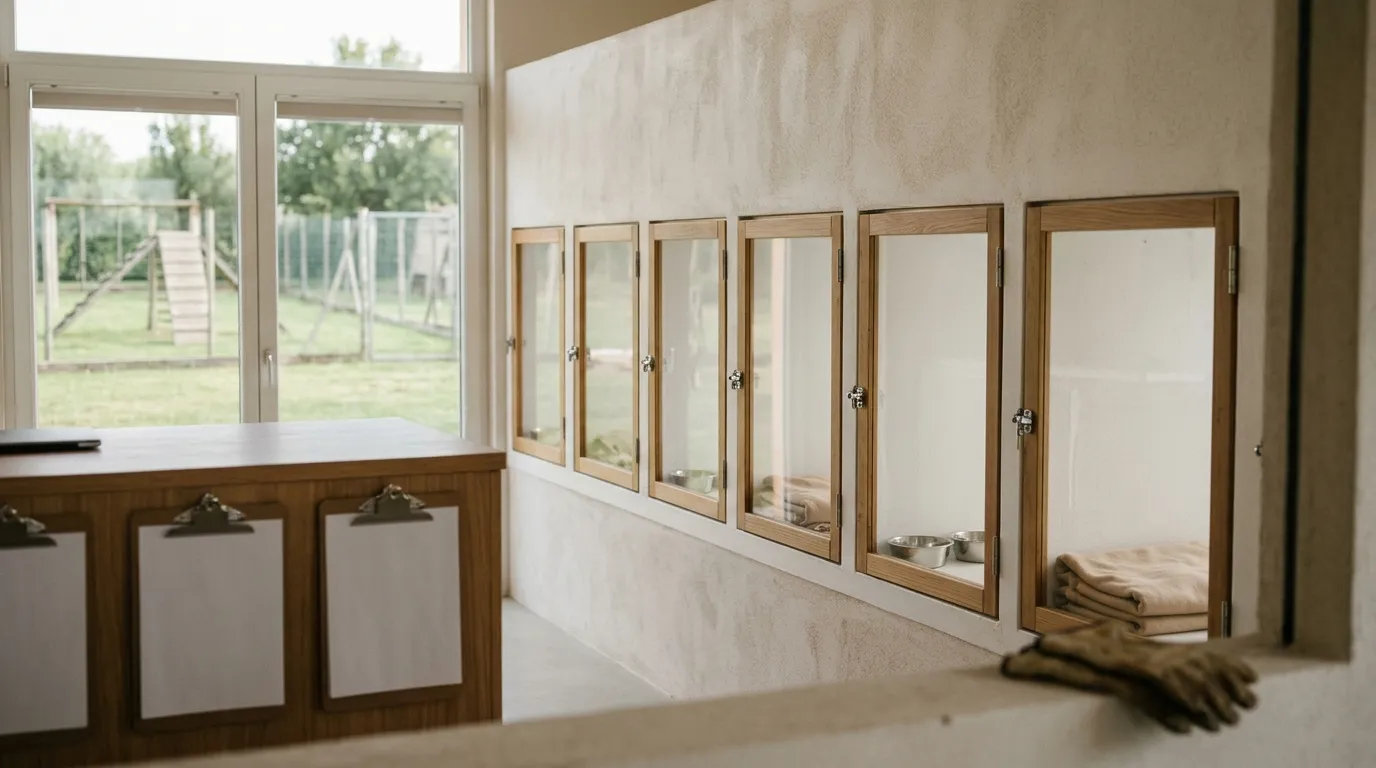
Dog and cat boarding kennel for sale: authorization, capacity, and value
A dog and cat boarding kennel is worth the income it can generate within its authorized capacity, plus the property that houses it. The health authorization is not bought separately: it is tied to the premises and the operator, and upon transfer, it must be transferred (voltura) or re-obtained. For this reason, authorization, capacity, and real estate matter more in the price than goodwill, which in this sector often remains tied to the owner's personal identity.
What you are buying when acquiring an animal boarding facility
An animal boarding facility is a business offering temporary custody of pets on behalf of their owners, for a fee, within an authorized structure. It is different from grooming, which sells care services and does not house animals. It is also different from a kennel/shelter, which accommodates animals without owners.
Whoever takes over a boarding facility generally buys five elements:
- the right to operate: the health authorization or equivalent title required by the region, with the indicated capacity;
- the structure: enclosures, catteries, exercise areas, isolation room, storage, often a plot of land in a suburban or agricultural area;
- the equipment: fencing, washing systems, box heating, any vehicles for picking up animals;
- the clientele: owners who return every holiday, bookings already collected, any agreements with veterinarians or groomers;
- ongoing relationships: employees, supply contracts, lease agreement if the property is not owned.
The business transfer transfers these elements as a single complex. Article 2556 of the Italian Civil Code requires a public deed or authenticated private agreement for businesses subject to registration. Article 2558 of the Italian Civil Code makes the buyer step into non-personal contracts. The health license instead follows its own administrative path, which must be managed in parallel with the deed.
The health authorization is the first asset to verify
The health authorization of a boarding facility is the provision that allows the custody of pets for third parties in a specific structure. It is issued by the Municipality, usually through the SUAP, upon the opinion of the ASL veterinary service. Some regions have replaced the authorization with a SCIA or registration.
The national reference that ASLs usually cite is the Veterinary Police Regulation (DPR 320/1954). The concrete requirements are set by regional laws and regulations on pets: box surface area, outdoor areas, separation by species and size, isolation room, waste management, maximum number of animals. For this reason, the same rules do not apply everywhere. You must read the regulations of the region where the structure is located.
What happens to the authorization when the operator changes
The license is tied to the structure and the entity managing it. A change of operator requires a succession (subingresso): a communication or a new application in the buyer's name. The authority can verify that the requirements are still met. An authorization issued many years ago does not guarantee that the structure complies with today's rules. If the regional regulation has changed, the buyer may find themselves having to adapt the boxes before operating. The general steps of the succession are explained in the guide on succession and transfer of licenses and authorizations.
The authorized capacity sets the revenue ceiling
The authorized capacity is the maximum number of animals that the structure can host simultaneously. The provision indicates this, often separated for dogs and cats. It is the data that weighs most heavily on the value, because no commercial strategy can exceed it.
The theoretical revenue of a boarding facility is calculated like this: authorized capacity × average daily rate × days of opening × occupancy rate. The decisive factor is the average annual occupancy rate, not the August sell-out. Demand is concentrated in summer, long weekends, and holidays, while in intermediate months many boxes remain empty. A structure full three months a year and half-empty for the rest is worth less than its peak period suggests.
Declared capacity and authorized capacity are not the same thing
In the advertisement or negotiation, capacity may be stated verbally or by counting the physically present boxes. The only figure that counts is that of the provision. If the structure has more boxes than the license authorizes animals for, those boxes do not generate legitimate revenues. An expansion requires a new application, and the outcome is not guaranteed: urban planning rules, distances from homes, and neighborhood noise issues all have an impact. An expansion yet to be authorized should not be paid for as if it had already been obtained.
How much is a dog and cat boarding facility worth
The value of an animal boarding facility is built in three steps.
- Normalized income. You start from the operating income and subtract a market compensation for the owner's labor. In many boarding facilities, the owner works seven days a week: if their labor is not paid, the declared income overestimates the business.
- Business value. A multiplier is applied to the normalized income. The multiplier drops if the income depends on the owner's presence, if the capacity is small, or if occupancy is highly seasonal.
- Adjustments. The value of the property is added, if it is sold. Necessary adjustments to maintain or transfer the license are subtracted.
The general method is explained in the guide on how much a commercial business is worth and how multipliers are used.
| Component | What it depends on | Weight on price |
|---|---|---|
| Health authorization | Validity, current compliance, possibility of succession | Necessary condition: without a transferable license, goodwill is worth little |
| Authorized capacity | Number of animals on the provision, division by species | Sets maximum revenue: it is the main variable |
| Real estate and land | Ownership or rent, urban planning compliance, distances | High if sold; if rented, remaining duration matters |
| Goodwill | Recurring clientele, bookings, reviews, tie to the owner | Variable: reduced if clientele follows the person |
| Boxes and equipment | Condition, materials, washing and heating systems | Medium: impacts especially if remodeling is needed |
| Accessory services | Grooming, training, pick-up and delivery | Increases revenue per customer and reduces seasonality |
The Sherlok Observatory, updated to novembre 2026, analyzes 812 ads across all sectors. It does not publish a median price for sectors below a minimum ad threshold, because too small a sample would provide a misleading number. Animal boarding facilities fall into this case: the value must be estimated based on the accounts of the individual structure.
Owned or rented property: why the value changes
A boarding facility needs outdoor spaces, distance from homes, and compatible urban zoning. For this reason, the property weighs more than in a shop. Moving the business elsewhere almost always means redoing the authorization process from scratch.
If the property is rented
Three elements matter: the remaining duration of the contract, the clause on intended use, and taking over the lease. For commercial leases, Article 36 of Law 392/1978 allows the contract to be transferred together with the business. The transfer must be communicated to the landlord, who can object for serious reasons. A lease close to expiration, without a guarantee of renewal, reduces the value of goodwill: the buyer risks paying for a business they will not be able to continue in the same location.
If the property is owned
The main verification is the urban planning and cadastral compliance of the buildings. Boxes, shelters, and fencing built in agricultural areas may not be regular. A building violation can block the succession or the sale of the property. The Sherlok dossier includes the integrated cadastral map, useful for checking parcels and boundaries before the inspection. A limit to know: the cadastral map does not cover the provinces of Trento and Bolzano, which use the land registry (tavolare) system.
What to check before buying a dog boarding facility
This is the recommended verification sequence for buyers:
- Health license. Request a copy of the authorization or equivalent title, with capacity by species. Verify that the license holder matches the seller.
- ASL checks. Request the latest inspection reports from the veterinary service and any still-open prescriptions.
- Regional rules. Compare the structure with current regional regulations and estimate the cost of adjustments.
- Real estate. Verify urban compliance, cadastral status, and the lease agreement, if any.
- Accounts. Request financial statements or tax returns for recent fiscal years. For sole proprietorships and partnerships, financial statements are not filed: "not filed" does not mean "not declared," but the figures must be requested from the seller and compared with tax returns.
- Actual occupancy. Reconstruct month-by-month occupancy from the attendance register, where required by regional regulations, and from already collected bookings.
- Staff and contracts. Employees transfer to the buyer according to Article 2112 of the Italian Civil Code. Also check contracts for waste disposal, drainage, and supplies.
- Debts. Article 2560 of the Italian Civil Code makes the buyer responsible for business debts appearing in mandatory accounting books. Request an updated statement.
- Conditional preliminary contract. Sign a preliminary agreement subject to the condition that the license succession goes through successfully.
- Final deed. The deed is executed before a notary. Registration tax on the business transfer is applied to the declared value, with different rates for goodwill and movable goods on one hand and real estate on the other.
On the seller's VAT number, the Sherlok dossier gathers data from official sources.
How to sell an animal boarding facility without losing value
The main risk for sellers is that the buyer considers the clientele tied to the owner's person, and therefore pays little for it. This is reduced with four moves:
- Documents ready before listing. Authorization, ASL reports, floor plans, and urban compliance shorten negotiations and remove grounds for discounting.
- Readable accounts. Separate personal costs from business costs and prepare monthly occupancy for recent fiscal years.
- Handover / Shadowing. Offer a transition period introducing the new operator to regular customers, particularly before the summer season.
- Non-competition. Article 2557 of the Italian Civil Code prohibits the seller from starting a competing business for five years from the transfer. For the buyer, this is a guarantee regarding clientele and should be explained during negotiations.
Confidentiality matters too: customers and employees should not discover the sale from a recognizable ad. Before setting a price, you can request a free valuation of your business. To publish, the page sell your business on Sherlok explains the model: you pay a subscription and there is no commission on the sale. Animal boarding facilities rarely appear among the ads. Those searching can start from the other sectors for sale category.
Frequently asked questions
Who issues the health authorization for a dog boarding kennel?
It is issued by the Municipality, usually through the SUAP, upon the opinion of the ASL veterinary service. In some regions, it is replaced by a SCIA or registration. Structural requirements and maximum capacity are set by regional laws and regulations on pets.
Does a boarding facility's authorization automatically transfer to the buyer?
No. A change of operator requires a succession in the buyer's name. The authority can verify that the structure still meets the requirements. It is wise to sign a preliminary contract conditional on the outcome of the succession.
What is the authorized capacity of an animal boarding facility?
It is the maximum number of animals the structure can accommodate simultaneously, indicated in the provision and often divided between dogs and cats. It sets the revenue ceiling and is the variable that weighs most heavily on the price.
How is the value of a dog and cat boarding facility calculated?
You start from the normalized income—meaning net of market compensation for the owner—and apply a multiplier. Then the property is added, if sold, and necessary adjustments to maintain the license are subtracted.
Is it worth buying a boarding facility with a rented property?
It depends on the remaining duration of the lease and the clause on intended use. Moving a boarding facility means redoing the authorization, so an expiring contract without a guaranteed renewal greatly reduces the value of goodwill.
Why is there no median price for animal boarding facilities?
The Sherlok Observatory does not publish medians for sectors below a minimum ad threshold because a small sample would provide misleading data. The value must be estimated based on the accounts and capacity of the individual structure.
If you are selling a boarding facility, start with a free valuation and prepare authorization, ASL reports, and accounts before publishing. If you want to acquire one, verify the title, capacity, and real estate with the dossier before making an offer.